

EVwire brief: New Jersey's Senate and Assembly committees have advanced bill S.1677/A.3968, which would set new hardware rules for the state's first autonomous vehicle pilot program.
The bill states that any fully driverless robotaxi would need a camera system plus two more, physically distinct sensor types built to keep working if the cameras fail, on top of 50,000 supervised miles logged on New Jersey's own roads before a company could drop its safety driver.
Tesla's Cybercab and its current Robotaxi fleet run on cameras and artificial intelligence alone. That would make them illegal to run driverless in New Jersey under the bill as written. As highlighted by Tesla community member Nic Cruz Patane on X:

Democratic state Sen. Andrew Zwicker, the bill's primary sponsor, is a physicist who works at the Princeton Plasma Physics Laboratory. He said that after riding in a Waymo robotaxi in Phoenix, he became convinced autonomous vehicles could transform transportation. "I was amazed how quickly you get used to it," he told The Verge.
He also maintained that the bill is not “anti-Tesla,” and he is simply “pro New Jersey safety.”
“At this point, I don’t think the evidence is sufficient that a single sensor with software can handle situations that humans can. Can we get there? Maybe. But we’re not there yet.”
Tesla disagrees, and is now directly campaigning against the bill.
“As written, the legislation imposes restrictions so severely that Tesla's autonomous vehicle technology couldn't legally operate in New Jersey. Rather than prioritizing real safety outcomes and performance, the bill specifically bans Tesla from the New Jersey market.”
Tesla frames this as a fight over who loses access: parents who want a safer school commute, aging residents who want to keep their independence, people with disabilities looking for more mobility options, and rural communities with little or no public transit.
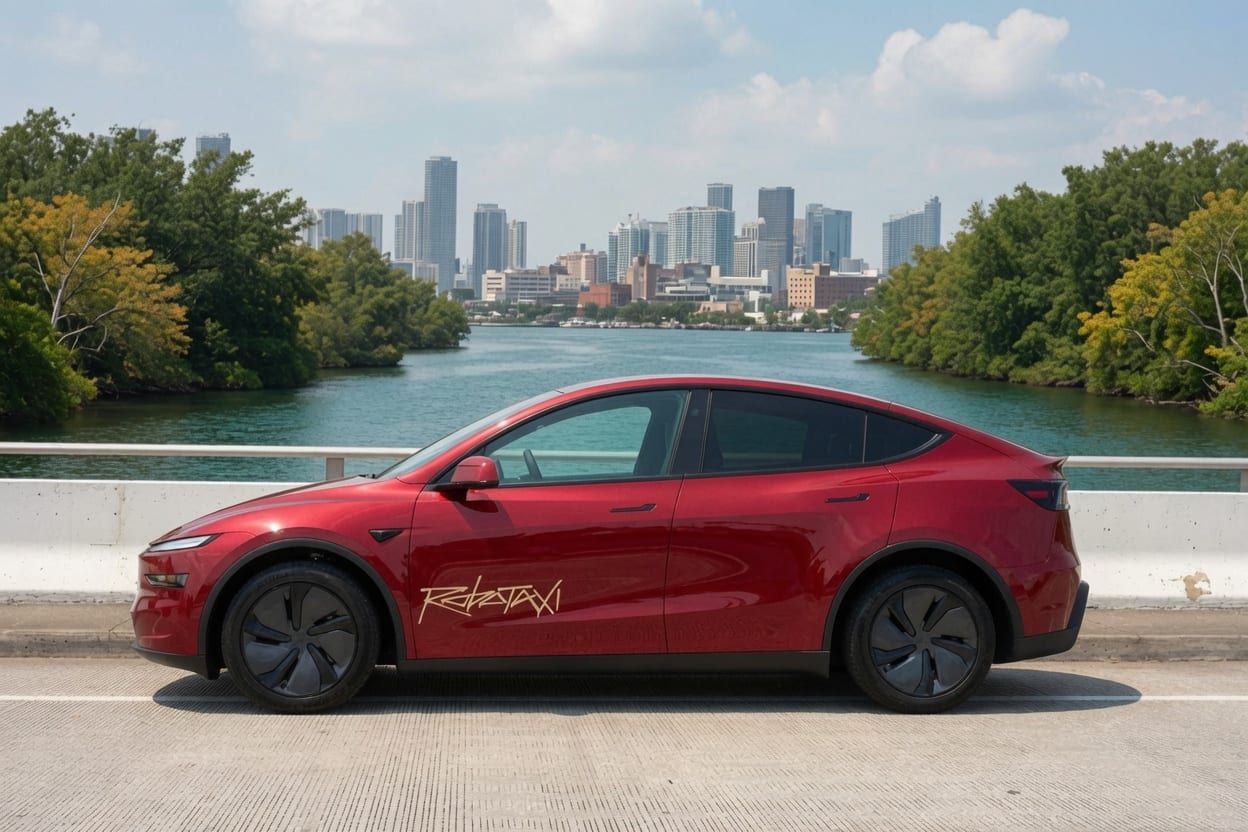
Tesla’s current Robotaxi fleet is made up of Model Y vehicles, which also navigate using only cameras and AI.
The company's case breaks into four parts:
Safety: Tesla says 578 people were killed in traffic incidents in New Jersey last year, and that more than 94% of serious crashes are attributable to human error such as impairment, distraction, and fatigue, factors it says autonomous vehicles simply don't have.
Mobility: the company argues the bill denies older and disabled residents a reliable, independent transportation option, and leave rural communities that lack public transit further behind.
Cost and congestion: Tesla says autonomous vehicles reduce congestion and emissions while offering a more affordable way to get around than the alternatives.
Jobs and tax revenue: nationally, Tesla points to hundreds of thousands of potential jobs, many without a college-degree requirement, and roughly $93 billion in additional federal tax revenue from wider AV adoption, benefits it argues New Jersey risks pushing to other states instead.
Tesla's ask to lawmakers: make the bill technology-neutral, open the pilot program to all qualified companies and full driverless vehicles, and build policy around outcomes rather than which sensors a company chooses.

Context:
Tesla's own numbers back up its safety argument. In Austin, where Tesla has run Robotaxi service the longest, NHTSA filings unredacted in May show just 19 reported incidents since launch, and zero major, at-fault crashes by Tesla's driving system.
Most are curb strikes, pothole damage, or run-ins caused by other road users: drivers rear-ending a stopped Tesla, a bus sideswiping it mid-turn, a scooter rider bumping its rear end. Two of the 19 happened when a human teleoperator, not the Tesla software, took manual control and scraped a fence or a construction barricade. None involved Tesla's fully unsupervised fleet, the vehicles running with nobody in the driver's seat at all.

Cameras, and only cameras: Tesla's Cybercab and Robotaxi fleet, backed by a clean at-fault record so far
The pattern holds at scale. Tesla's most recent Vehicle Safety Report puts FSD Supervised at one major collision every 5.3 million miles, more than eight times the US average of one every 660,000 miles, a comparison built on more than 4 billion FSD miles logged in the latest 12-month window alone.
Source: Tesla's Engage campaign page and The Verge
DIG DEEPER into Teslawire for more on Tesla's robotaxi push, check out our biweekly Robotaxi Report, and subscribe to join 14,000+ EV geeks.


